Summary
What is congenital adrenal hyperplasia (CAH)?
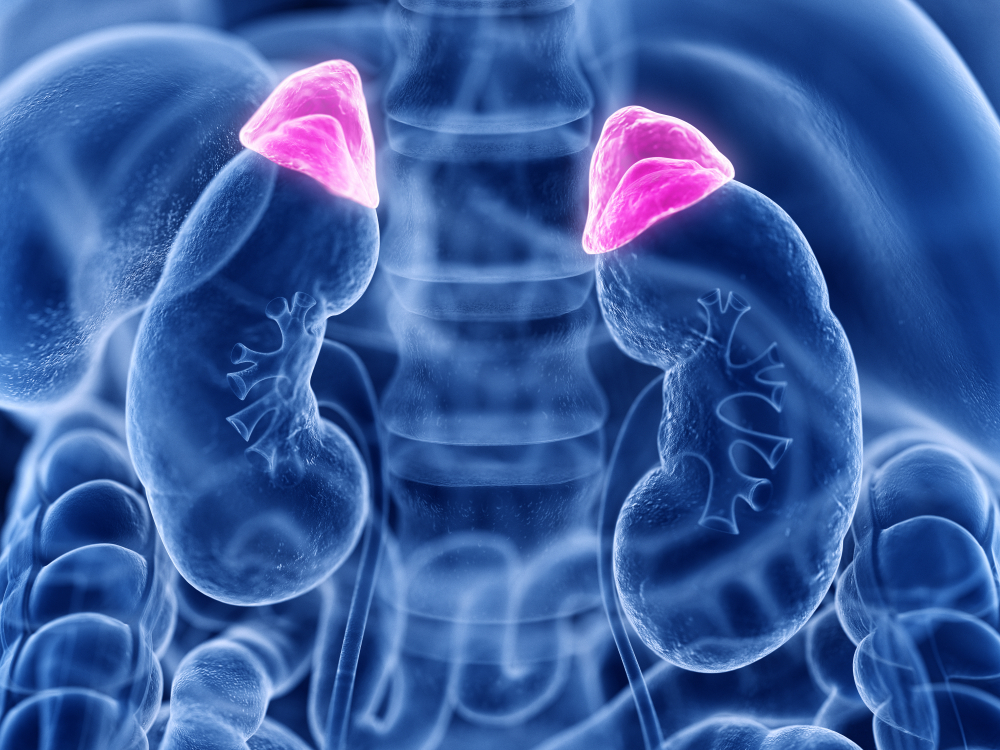
Your adrenal glands, which sit on top of your kidneys, make several important hormones, including:
The adrenal glands make hormones through a series of steps that begin with cholesterol. Cholesterol is synthesised into 17-hydroxyprogesterone (17-OHP). Next, three different pathways lead to the production of cortisol, aldosterone and sex hormones.
Along each pathway, several enzymes are needed to convert one substance into another. One of the most important of these is an enzyme called 21-hydroxylase.
Congenital adrenal hyperplasia (CAH) is a group of inherited disorders affecting these pathways. CAH occurs when someone inherits altered copies (variants) of a gene that controls one of these enzymes. About 95% of cases are caused by variants in the CYP21A2 gene, which controls the production of 21-hydroxylase. Data from newborn infants screened worldwide show an overall prevalence of about 1 in 14,000 to 1 in 18,000 births.
21-hydroxylase is needed to convert 17-OHP to cortisol and aldosterone. If you do not have enough of this enzyme, or it does not work properly, 17-OHP builds up and the excess is instead diverted into the pathway that makes male sex hormones (androgens).
The result is that not enough cortisol and sometimes not enough aldosterone are made while too much male sex hormone (androgens) is made.

When is 21-deoxycortisol tested?
Please note that 21-deoxycortisol is not the same as 21-hydroxylase. 21-hydroxylase is an enzyme, while 21-deoxycortisol is a hormone that can build up when this enzyme is not working properly.
The main test for 21-hydroxylase deficiency is 17-hydroxyprogesterone (17-OHP). Testing 21-deoxycortisol can provide additional evidence of 21-hydroxylase deficiency, if the level is raised. It can be particularly useful when the 17-OHP result is borderline or unclear.
17-OHP can sometimes be raised for reasons other than CAH, particularly in newborn babies, during illness or stress, and in some other adrenal conditions. Unlike 17-OHP, which can also be made by the ovaries and testes and is affected by stress, 21-deoxycortisol is made only by the adrenal glands. 17-OHP can indicate that the pathway is not working normally, while 21-deoxycortisol provides more specific evidence of 21-hydroxylase deficiency.
Measuring levels of 21-deoxycortisol can be used together with 17-OHP in helping to separate CAH from other causes of high levels of male sex hormones.
It can also be used to improve the accuracy of the short synacthen stimulation test.
Having the test
Sample
Blood
Any preparation?
None
Your results
21-deoxycortisol result What this may mean Normal (within the reference interval) This usually makes CAH due to 21-hydroxylase deficiency less likely. However, the result needs to be considered with your symptoms and other test results. Raised This supports a diagnosis of CAH. The higher the level, the greater the evidence that the 21-hydroxylase pathway is impaired. Your 21-deoxycortisol result is usually interpreted together with 17-OHP and other adrenal hormones.
Short synacthen (ACTH stimulation) test
If the result is unclear, 21-deoxycortisol can be measured as part of the short synacthen stimulation test. Blood is collected before and after synacthen is given. In 21-hydroxylase deficiency, stimulation of the adrenal glands can cause 21-deoxycortisol to rise markedly. For more see short synacthen test.
Newborn screening
Newborn screening (also known as the heel-prick test) for CAH uses 17‑OHP rather than 21‑deoxycortisol, but 21‑deoxycortisol may be used later to clarify borderline results.
Reading your test report
Your results will be presented along with those of your other tests on the same form. You will see separate columns or lines for each of these tests.
Reference intervals - comparing your results to the healthy population
Your results will be compared to reference intervals (sometimes called a normal range).
If your results are flagged as high or low this does not necessarily mean that anything is wrong. It depends on your personal situation.
Reference intervals for 21-deoxycortisol vary between laboratories in Australia because they use different measurement instruments.
Questions to ask your doctor
he choice of tests your doctor makes will be based on your medical history and symptoms. It is important that you tell them everything you think might help.
You play a central role in making sure your test results are accurate. Do everything you can to make sure the information you provide is correct and follow instructions closely.
Talk to your doctor about any medications you are taking. Find out if you need to fast or stop any particular foods or supplements. These may affect your results. Ask:
More information
Pathology and diagnostic imaging reports can be added to your My Health Record. You and your healthcare provider can now access your results whenever and wherever needed.
Get further trustworthy health information and advice from healthdirect.
What is Pathology Tests Explained?
Pathology Tests Explained (PTEx) is a not-for profit group managed by a consortium of Australasian medical and scientific organisations.
With up-to-date, evidence-based information about pathology tests it is a leading trusted source for consumers.
Information is prepared and reviewed by practising pathologists and scientists and is entirely free of any commercial influence.