
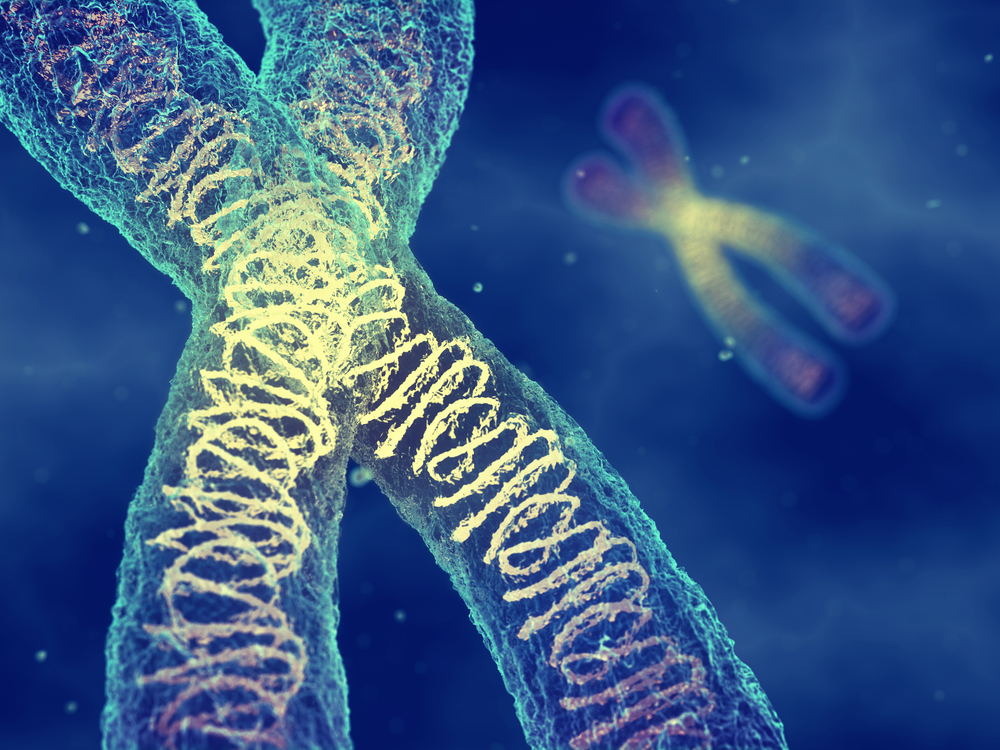
Our bodies are made up of trillions of cells. Almost every cell has a nucleus containing a complete set of our genetic material - our DNA. DNA is made of two matching strands twisted together like a spiral staircase, forming a double helix. This is tightly wound into structures called chromosomes.

Chromosomes are inherited from our parents. Usually, our cells have a set of 46 chromosomes arranged in 23 pairs. We get one of each pair from our mother and the other of the pair from our father.
Genes are short sections of DNA. Genes tell the body how to grow, work, and react to its surroundings. Genes do this by giving instructions to make proteins. Proteins are the molecules that do the work in cells.

Our cells have a lifespan – they get old and die off. Some cells last only a few hours or days, yet others last for months or years or even a lifetime. The cells in our body continuously divide to grow. Each time a cell divides, it copies its DNA and sometimes, small copying mistakes can occur. The alterations are also called variants.
Most alterations are harmless, and some are repaired automatically by our cells but as we age our DNA repair mechanisms weaken. This means that some abnormal cells survive and multiply.
When DNA is damaged, it can change the instructions. Cancer forms when accumulated DNA damage disables the mechanisms that normally control cell growth, repair, and death, allowing cells to grow and spread uncontrollably.

Homologous recombination repair (HRR) genes provide instructions for making proteins that help repair damaged DNA. They are particularly important for repairing double strand breaks in DNA. This is when both strands of the DNA ladder are broken, a type of damage known as a double-strand break. This repair process uses an undamaged copy of the DNA as a template, allowing the cell to repair the damage accurately.
Inherited disease-causing variants in some HRR genes can reduce the cell's ability to repair DNA damage. This allows genetic changes to accumulate, increasing the risk of certain cancers, particularly breast and ovarian cancer.
Homologous recombination repair genes provide the instructions for making proteins that detect and repair damage to DNA.
Some double-strand DNA breaks occur accidentally when cells are copying themselves. Environmental factors such as exposure to ionising radiation, certain chemicals, and some medications can also lead to double-strand DNA breaks.
Other double-strand DNA breaks are deliberately made by cells when genes are being rearranged to allow for essential processes.
For example, it happens when genes are mixed during the formation of eggs and sperm. It also happens when immune cells deliberately break and rejoin their DNA to create many different receptors, allowing the body to recognise a wide range of infections. These DNA breaks are carefully controlled and quickly repaired after rearrangement. Cells must repair DNA breaks quickly to prevent unintended alterations.
HRR is a highly accurate process that uses the matching chromosome as a template. Because we inherit two copies of each chromosome—one from each parent—there is usually a working copy available to guide the repair. This makes HRR one of the most accurate ways your cells can repair this type of damage.

HRR proteins act as a repair team. Some proteins detect the damage, others prepare the broken DNA and help locate an undamaged copy, while others help restore the missing genetic information and complete the repair. By working together, these proteins allow cells to repair DNA accurately and prevent harmful genetic changes from accumulating.
If you inherit a disease-causing variant in an HRR gene, the protein it produces may not work properly. This can make your cells less able to repair damaged DNA, allowing genetic changes to accumulate over time
HRR genes are tested when there is reason to suspect an inherited risk of cancer or when genetic information could help guide cancer treatment. Testing can be used:
Testing is not routinely recommended for everyone. Whether you are offered testing depends on your personal and family history, the type of cancer involved and whether the results are likely to influence your care.
The main HRR genes are:
BRCA1 and BRCA2 are HRR genes and usually tested together with the genes listed above as part of a multigene testing panel.
There are two types of testing:
Sample
Blood (for germline testing)
A sample of the tumour (for somatic tumour testing)
Any preparation?
None
A positive test result means a genetic variant has been identified in the genes tested. The variants identified may be called oncogenic, pathogenic or disease-causing variants. The variants of strong or potential clinical significance are highlighted, and the results will help your doctors select the most appropriate treatment for the variants identified.
It is important to note that a positive germline result indicates an inherited cancer predisposition, not a diagnosis of cancer. Inheriting an HRR gene variant does not mean you will necessarily develop cancer.
A negative result does not necessarily mean there is no inherited cancer risk. It means that no reportable disease-causing variant was identified within the limitations of the test.
Genetic testing reports are highly complex. They typically present the most important and relevant information first followed by supplementary information.
Genetic counselling is important as it helps people understand the benefits, limitations, and potential outcomes of familial BRCA1 and BRCA2, and HRR gene testing. It provides help in interpreting test results and their implications for cancer screening, prevention strategies, and cascade testing for family members who also be at risk of inheriting a pathogenic variant.
Common terms you may see on your report
Oncogenic variant - a genetic change known to cause disease or increase the risk of developing cancer.
Likely oncogenic variant - a genetic change that is strongly suspected to cause disease or increase cancer risk, although the evidence is not conclusive.
Variant of uncertain significance (VUS) - a genetic change has been found, but it is not known whether it is harmful or harmless.
Benign variant - a genetic change that does not cause disease or increase cancer risk
Likely benign variant - a genetic change that is very unlikely to cause disease or increase cancer risk.
Germline – inherited and present in all cells
Somatic – acquired during life and only present in cancer cells
Gene variant notation - results such as PALB2:c.3113G>A or p.{Trp1038Ter} describe the precise change in the DNA or protein sequence.
Copy number variation (CNV) - a section of DNA has been deleted or duplicated, changing the number of copies of a gene or part of a gene.
Biallelic inactivation - both copies of a gene have lost their normal function. In a tumour, this can be particularly important because it can severely impair DNA repair.
Tumour mutational burden (TMB) - a measure of the number of genetic changes in a tumour. It can help guide treatment decisions for some cancers.
Microsatellite instability (MSI) - changes in repeated sections of DNA caused by problems with a different DNA repair system, known as mismatch repair.
The choice of tests your doctor makes will be based on your medical history and symptoms. It is important that you tell them everything you think might help.
You play a central role in making sure your test results are accurate. Do everything you can to make sure the information you provide is correct and follow instructions closely.
Talk to your doctor about any medications you are taking. Find out if you need to fast or stop any particular foods or supplements. These may affect your results. Ask: